

Specify the wrong cover glass and your kiosk fails in the most visible way possible: users cannot read the screen under ceiling lights, fingerprints cover the surface by noon, or the display washes out near a window. Three letters solve most of these problems — AG, AR, and AF — but they are constantly confused. Here is what each coating actually does, and when to pay for it.
AG: Anti-Glare
Anti-glare glass has an etched or sprayed matte surface that scatters reflected light. Instead of seeing a mirror image of a ceiling lamp, the user sees a soft, diffused haze.
- Best for: Indoor kiosks under strong point lighting (malls, airports, hospitals), where mirror reflections are the main complaint.
- Trade-off: The matte texture slightly reduces sharpness and contrast. On high-resolution displays showing small text, heavy AG etching can create a “sparkle” effect.
- Cost: Low. This is the baseline treatment for most commercial touch glass.
AR: Anti-Reflective
Anti-reflective coating is an optical thin-film layer that reduces surface reflectance from around 4–5% (bare glass) to below 1%. Unlike AG, it does not diffuse light — it actually lets more display light through while cutting reflections.
- Best for: Semi-outdoor kiosks, window-facing installations, ticketing machines in glass halls — anywhere ambient light fights with the display. AR pairs naturally with high-brightness panels.
- Trade-off: Cost and durability. AR films are softer than glass; on heavy-traffic public kiosks, ask for hard-coated AR or laminated AR film.
- Cost: Medium to high, depending on process.
AF: Anti-Fingerprint
Anti-fingerprint (oleophobic) coating makes the glass surface repel skin oils. Fingerprints still appear — but they are faint and wipe off with one pass of a dry cloth instead of smearing.
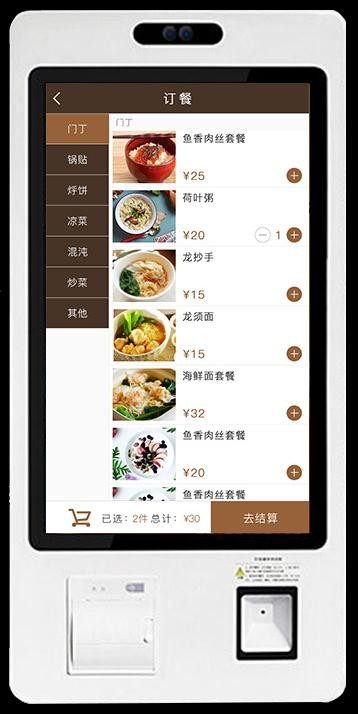
- Best for: Every public touch screen. Self-ordering kiosks in restaurants are the extreme case: greasy fingers, thousands of touches per day.
- Trade-off: AF coatings wear. Quality coatings last 1–2 years of heavy use before the effect fades. Ask your supplier about the wear test standard (steel wool rub cycles) behind their claim.
- Cost: Low — and it is the coating users notice most, because a dirty screen reads as a broken screen.
What About Vandal Resistance?
Coatings are surface treatments; impact resistance is a glass structure question. For unsupervised public kiosks, specify:
- Tempered glass, minimum 3–4 mm for indoor, 6 mm for exposed outdoor positions
- Chemically strengthened glass where weight matters
- Laminated construction if breakage containment is required (transport, government sites)
A 6 mm tempered front glass with AG + AF covers most outdoor kiosk requirements at reasonable cost. Add AR only when the brightness budget demands it.
How to Specify (So Your Supplier Cannot Misread You)
Write it like this in your RFQ:
Cover glass: 4 mm tempered, AG (gloss level 70 ± 15), AF coating, black silk-print border per drawing. Optional: AR treatment for outdoor variant.
Vague requests like “anti-glare glass” invite suppliers to quote whatever they stock. Numbers and drawings get you what you actually designed.
FAQ
Q: Can I get AG + AR + AF on the same glass?
Yes — AG etching on the outer surface, AR film, and AF top coat can be combined. This is the premium stack for outdoor ticketing and payment kiosks. Expect a noticeable cost adder.
Q: Does AG affect touch performance?
No. These coatings are optically thin or surface-etched; PCAP touch works normally through them.
Q: My kiosks are indoors with normal office lighting. What do I need?
AG + AF is enough. Spend the AR budget on a brighter panel only if the site has strong window light.
Not sure which glass stack your project needs? Tell us the installation environment — indoor, window-facing, semi-outdoor, or full outdoor — and we will recommend a glass specification with your quote: sales@lftouch.com