

“Make it waterproof” is one of the most common — and most dangerous — sentences in outdoor kiosk projects. Waterproof is not a spec. IP ratings are. Choosing between IP54 and IP65 (and knowing what each actually promises) is the difference between a kiosk that survives five rainy seasons and one that fails in the first monsoon — or, just as bad, a kiosk that is over-engineered and over-priced for a sheltered location.
What the Two Digits Mean
An IP (Ingress Protection) rating has two digits. The first covers solids — dust and foreign objects. The second covers liquids — water in various forms.
- First digit 5: dust-protected. Dust may enter, but not enough to interfere with operation.
- First digit 6: dust-tight. No dust ingress at all.
- Second digit 4: protected against splashing water from any direction.
- Second digit 5: protected against low-pressure water jets from any direction.
So IP54 = dust-protected + splash-proof, and IP65 = dust-tight + jet-proof. Note that neither rating says anything about immersion, corrosion, UV or temperature — those need separate design attention.
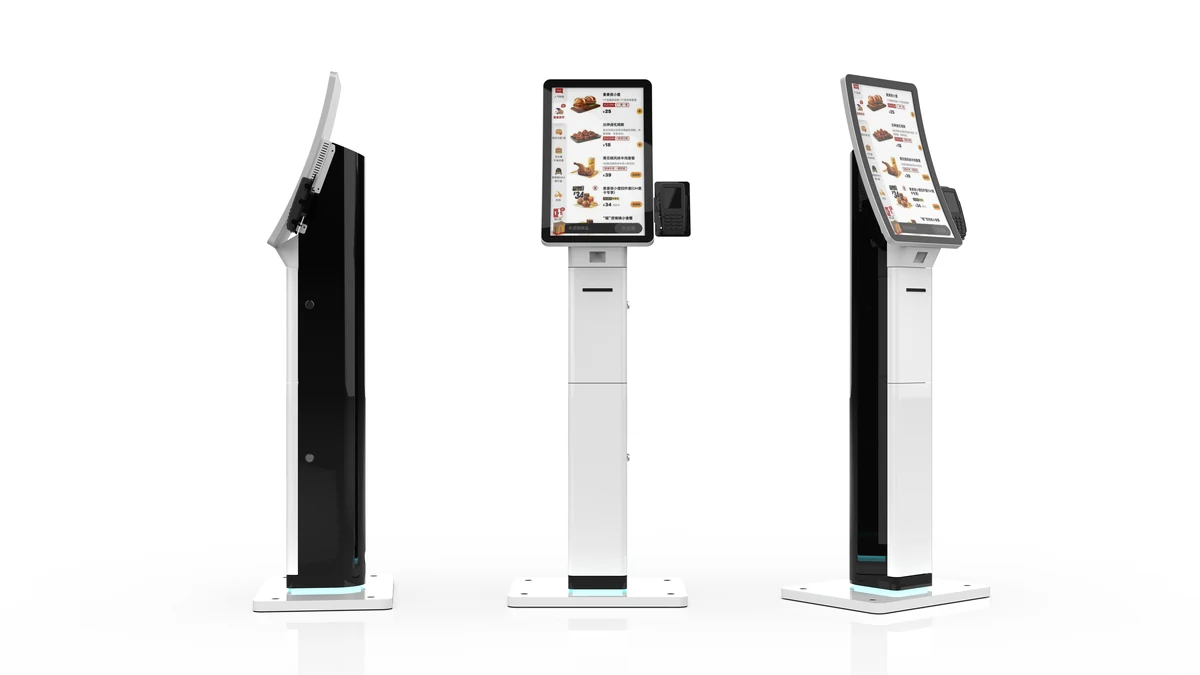
When IP54 Is Enough
IP54 suits semi-outdoor and sheltered installations: kiosks under canopies, in station concourses, parking entrances with roof cover, or covered drive-through lanes. Rain hits these machines as wind-driven splashes, not direct jets, and a well-designed IP54 front with proper drainage handles that for years. Many “outdoor” kiosks in real deployments actually live in IP54 conditions — specifying IP65 here adds cost and thermal compromise without adding real protection.
If your site has a roof or partial walls, photograph it during the worst weather of the season and share the picture with your manufacturer — a five-minute conversation often moves a project from IP65 down to IP54 and saves real budget without sacrificing reliability.
When You Genuinely Need an IP65 Outdoor Kiosk
An IP65 outdoor kiosk is the right call when the machine stands fully exposed: highway service areas, outdoor ticketing, car wash terminals, curbside payment, fuel forecourts and exposed queue-management terminals. These machines take direct rain, hose-down cleaning and wind-driven dust. The dust-tight first digit also matters in desert, construction and agricultural environments where fine particles would otherwise accumulate inside the enclosure.
A useful field test: if maintenance staff will ever clean the kiosk with a hose or pressure washer, specify IP65. Splashing-rated equipment does not survive well-intentioned cleaning crews.
The Rating Is Only as Strong as the Weakest Opening
Here is what datasheets do not tell you: a kiosk’s real-world ingress protection is defined by its worst detail, not its best panel. Buyers should ask about:
- Front assembly: how the touch monitor is sealed to the enclosure (gasket design, compression, glass bonding).
- Vents and fans: filtered, louvered or sealed-with-heat-exchanger designs behave very differently.
- Connectors and cable entries: cable glands, drip loops and bottom-entry routing.
- Doors and service panels: hinge-side sealing, latch compression and lock barrels.
A kiosk that is IP65 on the front but has an unsealed fan cut-out on the back is not an IP65 kiosk. Ask your manufacturer how the whole enclosure is tested, not just the display window.
Testing and Verification
For outdoor projects, ask for the test method, not just the rating claim. Serious factories verify spray and jet resistance on complete assemblies and check sealing again after final assembly, because a gasket pinched during production voids the rating quietly. Sample-stage verification is far cheaper than a warranty claim from a flooded parking terminal.
What IP Ratings Don’t Cover
Two kiosks with identical IP65 ratings can age completely differently outdoors, because the rating says nothing about several threats that matter just as much:
- Temperature: internal heat build-up and cold starts need their own thermal design — fans, filters, heaters or heat exchangers.
- UV exposure: sunlight degrades plastics, gaskets and coatings over years; materials must be specified for it.
- Corrosion: coastal salt air attacks ordinary finishes; powder-coat systems and hardware choices need to match the site.
A complete outdoor specification names the IP rating and the climate conditions. One without the other is half a spec.
The Practical Takeaway
Match the rating to the real site conditions: sheltered installations are usually well served by IP54; fully exposed, hose-cleaned or dust-heavy sites call for a true IP65 outdoor kiosk. Over-specifying wastes money and adds heat-management problems; under-specifying kills machines in the field.
LFTouch builds outdoor kiosks and high-brightness outdoor displays from 43″ to 65″ in our own factory, with sealed front assemblies and full final inspection on every unit. Tell us where your kiosks will be installed — we will recommend the right protection level and quote your custom design within 48 hours.