

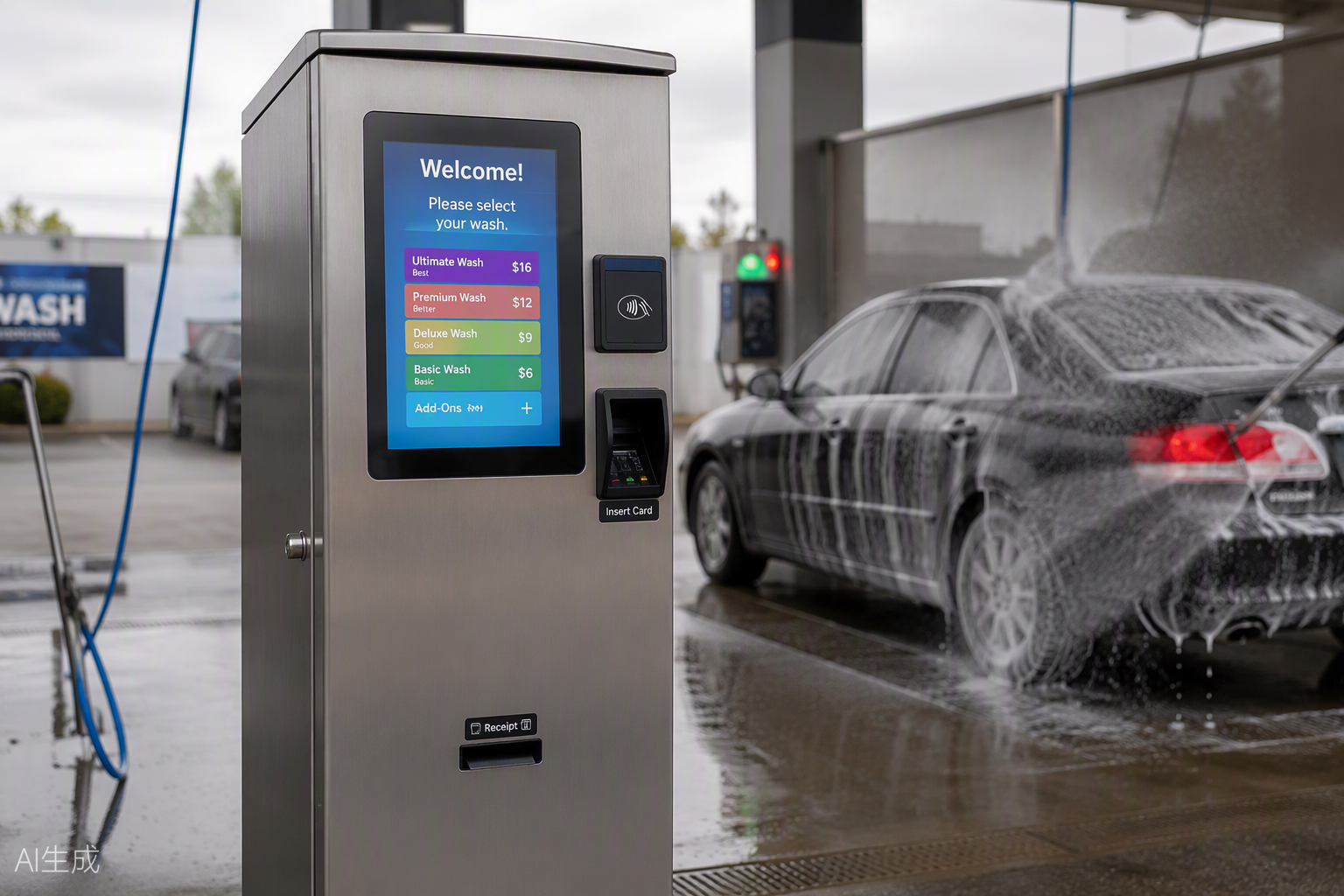
A payment terminal at a self-service car wash might be the hardest-working kiosk in any industry. It stands outdoors, unsupervised, facing a queue of cars — while being hit with high-pressure overspray, alkaline detergent, foam and wax, day after day, in every season.
Standard kiosk hardware does not last long here. The good news: failures in car wash environments are predictable, which means they can be specified away at the drawing stage. Here’s what actually matters.
Know What the Terminal Faces Every Day
A car wash pay station doesn’t just “get wet occasionally.” It deals with pressure-washer overspray from customers rinsing the bay, splashes of pH-aggressive detergent and wax, foam brush splatter, full sun in summer, freeze-thaw cycles in winter, and the occasional nudge from a vehicle mirror. Add 24/7 availability and minimal staff attention, and you have an environment closer to a piece of marine equipment than to a retail kiosk.
Ingress Protection: Think Beyond the Front Panel
Most buyers ask for “an IP65 screen” and stop there. But water at a car wash comes from every direction — including below, where spray bounces off wet concrete. The front panel needs IP65; the whole terminal needs a sealing strategy.
That means compression gaskets on every door and service panel, bottom-entry cable glands with drip loops, sealed locks and latches, and no exposed fan cut-outs on the back. Remember the weakest-opening principle: a terminal that is IP65 at the screen but has an unsealed printer door is, in practice, not IP65 at all. We covered how to read and verify ratings in detail in our IP54 vs IP65 guide.
Materials and Finish
Enclosure material decides how the terminal looks in year three. Powder-coated galvanized steel works when the coating system is specified for chemical and UV exposure; 304 stainless steel costs more but shrugs off detergent splash and road salt. Whichever you choose, ask what the finish has been tested against — a coating rated for indoor shelving will chalk and peel within a year at a wash bay.
The touch glass deserves the same attention. Anti-fingerprint coatings make daily wipe-downs easier, but cheap coatings wear off under frequent cleaning with strong chemicals. Tempered glass of 3–4 mm handles both cleaning abuse and impact.
Touch Screens That Ignore Water
Water on a capacitive touch screen can trigger phantom touches or block input entirely — a real problem when the customer is standing in front of the terminal with a dripping foam brush in hand. The fix is PCAP firmware with proper water rejection, and the implementation quality varies widely between suppliers.
Test it before you commit: run the terminal with the screen visibly wet, with droplets running down the glass. Gloves matter too — in cold climates, customers will try to operate the screen wearing them. Our kiosk sample testing protocol covers wet-screen and glove tests you can run yourself in an afternoon.
Payment Modules Need Sealing Too
The display usually gets the attention; the payment hardware is where water actually gets in. Card readers, bill acceptors and coin mechanisms each carry their own ingress rating, and each opening in the cabinet is a potential leak path. Look for reader bezels with their own gaskets, drip edges above every slot, and drainage channels that route water away from electronics instead of around them.
On the integration side, standard interfaces make life easier: MDB, pulse and RS232 connections let your local payment partner attach their preferred card reader or coin acceptor without custom engineering — we explained how these interfaces work in our payment integration guide.
Heat, Cold and Condensation
A car wash terminal in a cold region needs more than a wide-temperature rating. Internal heaters with thermostatic control keep electronics above condensation point overnight; insulated cabinet walls slow thermal shock. In humid climates the problem inverts — warm moist air meets a cold screen at dawn, and fog forms inside the glass if the assembly isn’t sealed or bonded. Ask your supplier how the terminal handles the first cold morning after a hot day, because that is when condensation failures appear.
Structure and Physical Protection
The terminal stands within reach of vehicles, so anchor it properly and consider bollards in the site layout. The cabinet itself should resist prying at the cash and card areas, and the front assembly should carry a meaningful impact rating — IK09 or IK10-class protection at the glass — because wash bays see everything from thrown stones to bumper taps.
A Short Spec Checklist Before You Order
- IP65 at the front, with whole-unit sealing verified — not just the screen
- 1,000+ nits brightness if the terminal stands unsheltered
- PCAP touch with demonstrated water rejection, tested wet
- Stainless or chemical-rated powder-coat finish, UV-stable
- Sealed payment modules with drip edges and drainage
- Heater and condensation strategy for cold or humid sites
- Impact-rated front glass and a bollard plan for the site
FAQ
Q: What IP rating does a car wash kiosk need?
A: IP65 at the front as a minimum, with the whole cabinet sealed — gasketed doors, bottom-entry cable glands and no unsealed vents. The unit is only as strong as its weakest opening.
Q: Will a capacitive touch screen work when wet?
A: Yes, if the touch controller has properly tuned water-rejection firmware. Ask for a wet-screen demonstration before approving the sample — implementations differ significantly between suppliers.
Q: Stainless steel or powder-coated steel for the cabinet?
A: Powder-coated steel is cost-effective when the coating system is rated for chemical and UV exposure. 304 stainless costs more and is the safer choice where detergent splash, salt air or coastal corrosion are factors.
Q: Can the kiosk integrate our local payment provider’s card reader?
A: In most cases, yes. Standard MDB, pulse and RS232 interfaces allow local payment partners to connect card readers, coin acceptors or QR modules without custom development.
Building a Car Wash or Outdoor Payment Project?
LFTouch manufactures self-service kiosks and custom kiosk cabinets with in-house sheet-metal fabrication, sealed payment bays and outdoor-rated touch displays — factory-direct, backed by 20 years of manufacturing background. Send your site conditions and module list through our contact form or WhatsApp, and we’ll reply with a configuration and quotation.