

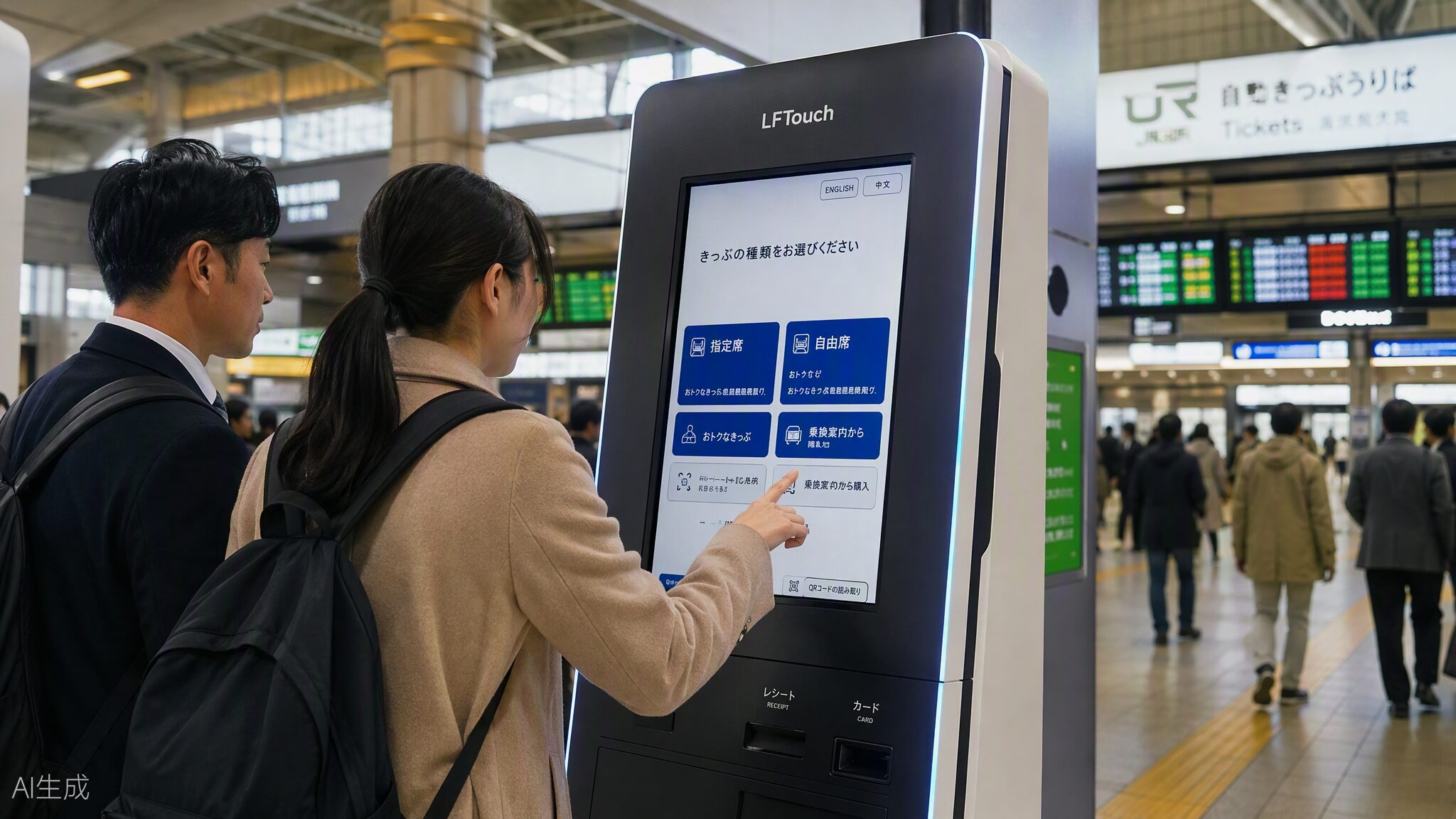
Japan runs the densest self-service economy on earth. Ticket machines at every station, food ticket vendors at ramen shops, unmanned convenience stores, self-service kiosks at supermarkets — millions of terminals serving millions of people daily, with no staff member in sight.
When a market operates unattended terminals at that scale for decades, it teaches the rest of the world what actually matters in a display. These lessons apply whether your project is in Osaka or Ohio.
Lesson 1: Uptime Is the Only Metric That Matters
An unattended terminal that fails does not just lose a sale — it loses trust, and in Japan’s service culture, that is unforgivable. Display selection follows from this:
- Industrial panels with 30,000–50,000 hour backlights are the baseline, not the upgrade. At 24/7 operation, a 50,000h backlight still ages 8,760 hours every year.
- Wide-temperature components: terminals sit in semi-outdoor station entrances, underground malls and unheated corridors. Consumer panels show their limits in the first winter.
- Proven models over new models: Japanese operators famously favor mature designs with years of field data. When qualifying a display, ask how long that exact model has been in production.
Lesson 2: Design for the Repair, Not Just the Operation
Unattended means the nearest technician may be an hour away. Japanese kiosk design treats maintenance as a first-class requirement:
- Front-serviceable or quick-swap display modules: a trained technician should replace a screen in minutes, with standard tools.
- Standardized mounting and connectors across the fleet — one spare unit covers every site.
- Brightness headroom: backlights dim over years. Specifying 20–30% more brightness than day-one needs keeps the screen readable in year five.
When you specify displays, ask the factory for the replacement procedure and spare-part lead time before you ask for the price.
Lesson 3: Compact, Readable, Reachable
Japanese terminals achieve remarkable information density in small footprints:
- 10.1″–21.5″ screens dominate, because terminals are placed where space costs money.
- Readability beats resolution: high contrast, anti-glare treatment and sensible UI scaling matter more than pixel count at arm’s length.
- Touch targets sized for everyone — the elderly are heavy self-service users in Japan, and interfaces that work for them work for everyone.
Lesson 4: Vandalism and Public Wear Are Design Inputs
Terminals live unsupervised in public. Covers get scratched, screens get poked with keys and umbrellas:
- Chemically strengthened cover glass (3–6 mm) with proper touch tuning underneath
- Sealed fronts (IP54–IP65) against spills, rain splash at entrances, and cleaning crews
- PCAP tuning that ignores water droplets, or IR touch where appropriate for the environment
Lesson 5: Quiet and Cool Is a Feature
Fanless, low-heat designs dominate Japanese terminals — screens sit centimeters from users in quiet stations. Fanless displays with efficient backlights reduce failure points (fans die before panels do) and keep the terminal silent and dust-free inside.
Applying This Outside Japan
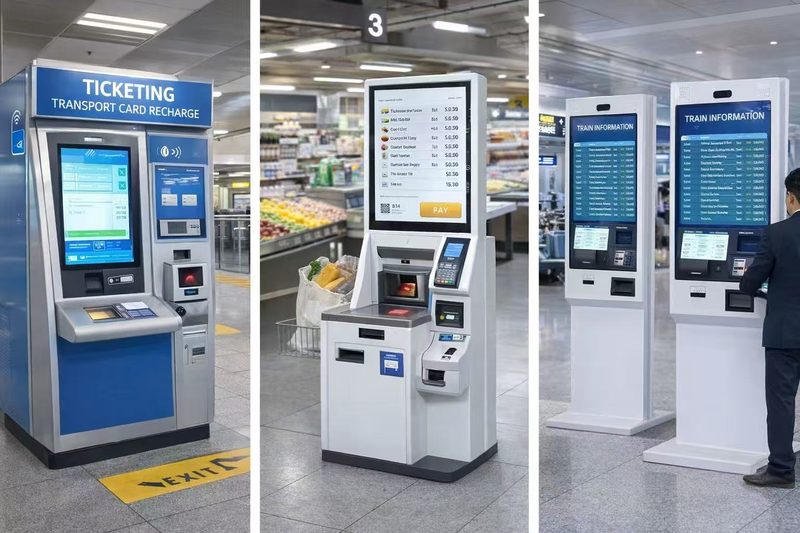
The unattended model is expanding globally: self-checkout in Southeast Asia, unattended retail in the US, ticketing kiosks in the Middle East. The Japanese playbook translates directly — specify for uptime, design for repair, standardize the fleet, and buy spares with the first order.
FAQ
Q1: What screen size works best for unattended payment terminals?
10.1″–15.6″ covers most payment and ordering scenarios. Go larger only when users browse rich content, like menus with photos or wayfinding maps.
Q2: How do we handle displays in semi-outdoor placements?
Combine three things: 700–1000 nit brightness, wide-temperature panels, and IP65 front sealing with proper enclosure drainage. Any one of the three alone is not enough.
Q3: What spare ratio do Japanese-style operators keep?
Typically 2–5% of the fleet, stored in-country. The cost of a spare on a shelf is trivial next to an unattended terminal dark for a week waiting on international freight.
Building an unattended terminal project? Tell us the environment and duty cycle — we will recommend a display configuration proven in 24/7 operation. Read our guide on Touch Screens for Restaurants & Retail Chains in Southeast Asia for regional deployment tips.